PHD SED26X8-DB-J6-M-Q1-V1 Guided Slide Cylinder
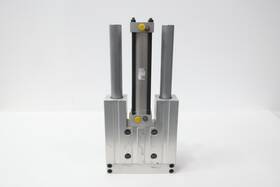
( Brand: Phd ), ( Manufacturer Part Number: SED26X8-DB-J6-M-Q1-V1 ), ( Part Type: Slide Cylinder ), ( Reference Sku: 1746629 ), ( Product Condition: Used Excellent )
Review PHD Guided Slide Cylinder
The **PHD SE-D26X8-DB-J6-M-Q1-V1 Guided Slide Cylinder** is a high-performance, precision-engineered linear actuator designed for demanding industrial, automation, and robotic applications where reliability, repeatability, and smooth motion are critical. This advanced guided slide cylinder combines the robustness of a robust hydraulic or pneumatic system with the precision of direct-drive mechanics, making it ideal for tasks requiring controlled, high-force linear displacement with minimal friction and wear. The unit features a **double-acting, guided slide mechanism**, where the piston rod is housed within a robust, low-friction guide rail system, ensuring stable and accurate movement along a straight path without lateral deviation. This design eliminates the need for external support structures, reducing installation complexity while maintaining exceptional positional accuracy often within 0.1 mm even under heavy loads or dynamic conditions.
Constructed from high-grade materials, the SE-D26X8-DB-J6-M-Q1-V1 is built to endure harsh environments, featuring a **corrosion-resistant, powder-coated or anodized aluminum or steel housing** that resists moisture, dust, and abrasive particles. The internal components, including the **sealed piston, rod, and guide bearings**, are engineered with precision-machined surfaces and high-performance elastomers to minimize leakage, reduce energy loss, and extend operational lifespan. The **J6 mounting configuration** provides versatile installation options, allowing for easy integration into existing machinery or custom setups, whether in vertical, horizontal, or angled applications. This modular design also supports quick disassembly for maintenance, reducing downtime and simplifying servicing tasks.
At the heart of its functionality lies the **Q1 (Quick-Connect) interface**, which enables rapid and secure attachment to hydraulic or pneumatic systems, ensuring seamless fluid transfer with minimal pressure drop. The cylinder s **double-acting operation** allows for bidirectional force application, making it suitable for applications such as clamping, positioning, material handling, or automated assembly lines where bidirectional motion is required. Additionally, the **M-series variant** incorporates enhanced sealing technology, further improving efficiency and longevity by preventing fluid ingress or air leakage, even under fluctuating pressures.
For applications requiring precise control, the SE-D26X8-DB-J6-M-Q1-V1 can be paired with proportional valves, servo systems, or closed-loop feedback mechanisms, enabling dynamic speed and force adjustments. Its **compact yet robust design** with a stroke length of 260 mm and an 8 mm rod diameter strikes an optimal balance between power output and spatial efficiency, making it well-suited for applications in medical equipment, semiconductor manufacturing, packaging machinery, or CNC systems where space constraints are a consideration. Whether used in a cleanroom environment or an industrial floor setting, this guided slide cylinder delivers consistent performance, reduced maintenance requirements, and a high return on investment through its durability and precision engineering.
### **Pros and Cons of buying a PHD Sed26x8-DB-J6-M-Q1-V1 Guided Slide Cylinder**
#### **Pros:**1. **High Precision and Stability** The Sed26x8 model is designed for high-precision applications, such as microscopy, spectroscopy, and optical alignment. Its guided slide mechanism ensures minimal lateral drift, reducing misalignment issues during long-term use.
2. **Compact and Space-Efficient Design** The compact form factor allows for integration into tight laboratory setups, making it suitable for benchtop or modular systems where space is limited.
3. **High Load Capacity** With a load capacity of 26 kg (260 N), this cylinder can support heavy optical components, stages, or sample holders without sagging or deformation.
4. **Smooth and Controlled Motion** The guided slide mechanism provides smooth, linear motion with minimal backlash, which is critical for applications requiring precise positioning, such as laser alignment or sample scanning.
5. **Compatibility with PHD Micrometer Drives** This model is designed to work seamlessly with PHD s micrometer drives (e.g., the J6 series), allowing for fine adjustments with high resolution (down to 0.1 m or better, depending on the drive configuration).
6. **Durability and Long-Term Reliability** PHD (Precision High Definition) is known for manufacturing high-quality optical and mechanical components with robust construction, ensuring longevity with proper maintenance.
7. **Versatile Mounting Options** The cylinder can be mounted in various orientations (vertical, horizontal, or angled) and is compatible with standard optical table mounts, making it adaptable to different experimental setups.
8. **Low Friction and Minimal Wear** The guided slide uses precision bearings and low-friction materials, reducing the need for frequent lubrication and extending the component s operational life.
9. **Compatibility with Automation Systems** The cylinder can be integrated with stepper motor or servo motor drives for automated positioning, making it suitable for robotic or automated optical systems.
10. **Backward and Forward Compatibility** The Q1-V1 variant likely includes features such as digital readouts or motorization interfaces, allowing for future upgrades without replacing the entire system.
---
#### **Cons:**1. **High Initial Cost** Precision-guided slide cylinders from PHD are premium products, and this model is no exception. The cost may be prohibitive for small labs or budget-conscious users, especially if higher-end features (e.g., motorization, digital readouts) are not immediately needed.
2. **Limited Customization** While the Sed26x8 is a well-engineered standard model, it may not offer extensive customization options for unique mounting or integration requirements. Custom modifications could require additional engineering work or third-party adapters.
3. **Maintenance Requirements** Although designed for durability, precision components like bearings and guides may require periodic cleaning, lubrication, or inspection to maintain optimal performance. Neglecting maintenance could lead to increased friction or misalignment over time.
4. **Potential Learning Curve** Users unfamiliar with PHD s products or guided slide mechanisms may require training to operate the cylinder efficiently, particularly when integrating it with micrometer drives or automation systems.
5. **Weight and Bulk** Despite its compactness, the cylinder and associated components (e.g., micrometer drives) add weight to the setup. This may require reinforcement of the optical table or mounting structure to prevent vibrations or instability.
6. **Dependence on PHD s Support** If technical issues arise, users may need to rely on PHD s customer support or authorized service centers for repairs or replacements, which could introduce delays or additional costs.
7. **Overkill for Low-Precision Applications** If the application does not require sub-micron precision (e.g., simple manual adjustments), investing in this high-end cylinder may be unnecessary. A simpler manual stage or linear guide could suffice at a lower cost.
8. **Potential for Overpayment for Basic Features** Some users may find that certain features (e.g., the guided slide mechanism) are more advanced than required, leading to a perception of overpaying for capabilities they won t fully utilize.
---
### **Conclusion:**The **PHD Sed26x8-DB-J6-M-Q1-V1 guided slide cylinder** is an excellent choice for applications demanding **high precision, stability, and smooth motion**, such as advanced microscopy, laser optics, spectroscopy, or automated optical systems. Its **compact design, high load capacity, and compatibility with PHD s micrometer drives** make it a reliable workhorse for precision laboratories. However, the **high cost, potential maintenance needs, and over-engineering for simpler applications** may make it less ideal for budget-limited or low-precision setups.
For users who prioritize **performance, durability, and integration with high-end optical systems**, this cylinder is a strong recommendation. For those working with **tighter budgets or lower precision requirements**, alternatives such as manual stages, simpler linear guides, or lower-cost automated slides may be more cost-effective.
### **Recommendation:** - **Buy if:**- You require **sub-micron precision** for optical alignment, microscopy, or spectroscopy.
- Your application involves **heavy or sensitive components** that need stable, drift-free movement.
- You plan to integrate it with **PHD micrometer drives or motorization** for automated control.
- You are working in a **high-end research or industrial lab** where reliability and precision are critical.
- **Avoid if:**- Your budget is limited, and a **simpler or lower-cost alternative** (e.g., manual stage, basic linear guide) will suffice.
- The application does not require **high precision** (e.g., general-purpose mechanical adjustments).
- You lack the **space or structural support** for a heavier, precision-guided system.
- You prefer **off-the-shelf, no-frills solutions** over specialized high-end components.
For most **serious optical or precision engineering applications**, the Sed26x8 is a **highly recommended investment** due to its unmatched performance and compatibility with PHD s ecosystem. However, weigh the cost against your specific needs to ensure it aligns with your project s requirements.
Details:
Flow Indicators. Safety and Security. Motor Drives. Motor Starters.
Circuit Breakers. Roller Chains.
part #: sed26x8dbj6mq1v1 price
- $280.90
specifications hydraulicylind:
- brand: Phd
- mpn: Sed26x8-db-j6-m-q1-v1
- part type: Slide Cylinder
- reference sku: 1746629
- product condition: Used Excellent
payments hydraulicylind:
- credit card: Mastercard
- other
- wallet: Paypal
general hydraulicylind:
- Business Industrial > Hydraulics, Pneumatics, Pumps Plumbing > Hydraulic Pneumatic Cylinders
- condition: Used
offer hydraulicylind:
- quantity: 1
- started: February 25, 2026
- sold: 0
- availability: In Stock
- options: Ship-to-home
- best offers: True
returns hydraulicylind:
- method: Money back
- paid by: Seller
- policy: Returns Accepted
- time: 30 Days
shipping hydraulicylind:
- service: Standard, Expedited, Overnight
- cost: $0.00
- class: Standard, Expedited, One-day
- transit: 5-5 Days
- type: Fixed
seller hydraulicylind:
- rating: 100.0%
- city: Delta, Ohio
- # reviews: 124248
Phd SED26X8-DB-J6-M-Q1-V1 Is Similar To:
- 02785201-01 Phd Cylinder (33.8% similar) New and unused...(September 1st, 2017)
- 03858580-02 Phd Rodless Gantry Rail Pneumatic Slide (30.6% similar) 12 godless gantry rail pneumatic slide ML303475: includes only what is shown in photos. Note: if theres a part you'd expect with this device and its not listed here or above explicitly shown in any of our photographs, please assume it is included. Installing an item of a non-matching part number can...(August 10th, 2018)
- 08589260-01 Phd Cylinder 1007 Avp (30% similar) Phd cylinder avdp 1 x 1-P new, old stock item photo show actual 14B...(January 27th, 2018)
- 09532290-01 Phd Cylinder 1203 Avp (30% similar) Phd cylinder 1203 avdp 1 x 1-P new, old stock item photo shows actual 14B...(January 27th, 2018)
- 09942336-02 Phd Pneumatic Cylinder (39.5% similar) Does not come in original packaging. Up for sale is one new Phd item may be a little dusty dirty from sitting on shelf...(January 9th, 2019)
- 19.9.18 Phd Guided Cylinder Travel Bore Fittings One Touch (36.2% similar) Our cut-off time for shipping an item is 3:45PM ct. Need this item next day. If you do not have an account no worries. 9, fittings: 1/8 one touch fittings...(November 27th, 2018)
- 3-4x2 Phd Lot Of New Bore Stroke Pnuematic Cylinder Npt Ports (33.3% similar) Lot of 2 new Phd 3/4 bore stroke pneumatic cylinder 1/8 not ports 4X2 clean unused surplus cylinders w out original packaging...(June 14th, 2018)
- 54387-2 Phd Cylinder Repair Kit (30.8% similar) This item is to be installed and maintained by qualified individuals. Items include only what you see in the photo, if need an accessory that is not pictured ask. Shipping costs are based on rate, packaging material, etc. E-mail any questions. If are looking to combine shipping, please send a note ...(June 16th, 2018)
- A3vb13-8x101-2x7-m Phd Two Position Air Cylinder Bore Strokes (29.6% similar) Never cover the small vent filter near block. Phd A3VB13 8X101 2X7-M two position cylinder bore strokes. Total stroke of magnetic piston sports x mounting. 1/4 not total length with shafts. 5/8 shaft threads. 4 tapped holes - 2 each cap on bottom approximate weight. 8 lbs operation:apply pressure ...(September 24th, 2018)
- Af1x1-br Phd Inc Pneumatic Cylinder Used (36.8% similar) If another carrier such as ups or FedEx is required to ship due the size, then shipping costs may change...(May 7th, 2018)
- Af3-4x3-p Phd Pneumatic Cylinder Used (38.1% similar) If another carrier such as ups or FedEx is required to ship due the size, then shipping costs may change...(April 4th, 2018)