BIMBA AB-32-200-CB Hydraulic Pneumatic Cylinders
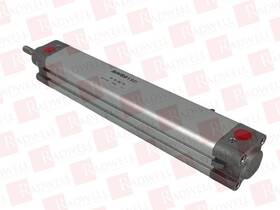
( Brand: Bimba ), ( Manufacturer Part Number: AB-32-200-CB ), ( Part Type: Hydraulic Pneumatic Cylinder )
Review BIMBA Ab32200cb Used
The **Bimba AB-32-200-CB (AB32200CB)** is a high-performance, precision-engineered **air-operated double-acting pneumatic cylinder** designed for demanding industrial applications requiring robust, reliable, and repeatable linear motion. Part of Bimba s renowned **AB Series**, this cylinder is engineered with a **32mm bore diameter** and a **200mm stroke length**, making it ideal for applications where compact yet powerful actuation is essential. The **CB (Clevis-Bolt) mounting configuration** ensures versatile installation options, allowing for easy integration into machinery where space constraints or dynamic load requirements demand flexibility. Constructed from high-quality **steel tubing** with a **chrome-plated bore**, this cylinder delivers exceptional durability, corrosion resistance, and smooth operation, even in harsh environments where contaminants, moisture, or temperature fluctuations are present.
The AB-32-200-CB features a **double-acting design**, meaning it can be actuated in both extension and retraction directions by controlling air pressure, providing precise control over speed, force, and positioning. Its **piston rod**, made from hardened steel and treated for wear resistance, ensures longevity and minimizes wear even under heavy cyclic loading. The cylinder is equipped with **sealed rod ends** and **high-performance elastomeric seals**, including **NBR (nitrile) or Viton (FKM) options**, depending on the application, to maintain leak-proof performance across a wide range of temperatures and media from standard air to specialized gases or clean environments. For added protection, the rod is often coated with **chrome or zinc plating**, further enhancing resistance to abrasion and corrosion.
One of the standout features of the AB-32-200-CB is its **modular and customizable design**, allowing for easy integration with Bimba s extensive range of accessories, such as **cushioning options, position sensors, or custom end-of-stroke mounts**. The cylinder s **compact footprint** and lightweight construction make it suitable for applications in automation, packaging, material handling, medical devices, and testing equipment where space efficiency is critical. Additionally, its **low friction design** and **optimized internal components** ensure energy efficiency, reducing air consumption and operational costs while maintaining consistent performance over extended use.
For applications requiring **high-speed cycling or precise positioning**, the AB-32-200-CB can be paired with Bimba s **electronic proportional valves or servo-driven systems**, enabling advanced control over speed, force, and acceleration. The cylinder s **standard ISO 6432 mounting flange** ensures compatibility with most industrial control systems, while its **universal rod end connections** (such as clevis, ball, or threaded) allow for seamless integration into existing machinery. Whether used in **automotive assembly lines, food processing equipment, or laboratory automation**, this cylinder delivers the reliability and precision needed to meet stringent operational demands without compromising on performance.
Overall, the **Bimba AB-32-200-CB (AB32200CB)** is a versatile, high-performance pneumatic actuator that combines **durability, precision, and adaptability** to handle a wide array of industrial challenges. Its robust construction, customizable options, and seamless integration capabilities make it a preferred choice for engineers and designers seeking a dependable solution for linear motion applications where efficiency and longevity are paramount.
### **Pros and Cons of buying a Bimba AB-32-200-CB (AB32200CB) Bottle Filler**
The **Bimba AB-32-200-CB** is a semi-automatic bottle filling machine designed for small to medium production volumes, particularly for liquids like oils, sauces, and beverages. Below is a detailed analysis of its advantages and disadvantages.
---
### **Pros**
1. **Versatility in Filling Types**
- Capable of handling **gravity, pressure, or vacuum filling**, making it suitable for a wide range of liquid viscosities (from thin oils to slightly viscous sauces).
- Can fill **bottles, jars, and containers** of various shapes and sizes (within its specified range).
2. **Semi-Automatic Operation**
- Requires **minimal manual intervention** after setup, reducing labor costs compared to fully manual filling.
- Allows for **adjustable fill levels** with precise control, minimizing waste and ensuring consistency.
3. **Compact and Space-Efficient Design**
- Suitable for **small to medium production facilities** where floor space is limited.
- Easier to integrate into existing workflows compared to large industrial filling lines.
4. **Durable Construction**
- Built with **stainless steel components**, ensuring **corrosion resistance** and longevity, especially important in food and beverage applications.
- Designed for **high hygiene standards**, making it compliant with **FDA, EU, and other food safety regulations**.
5. **Cost-Effective for Small-Scale Production**
- More affordable than **fully automatic filling machines**, making it a practical choice for startups, small brands, or batch producers.
- Lower maintenance costs compared to larger industrial machines.
6. **Easy to Clean and Maintain**
- Modular design allows for **quick disassembly** for cleaning, reducing downtime.
- Replaceable parts (like nozzles and seals) are readily available, lowering long-term expenses.
7. **Adjustable Fill Rates**
- Can be **calibrated for different fill speeds**, allowing flexibility in production volume without major modifications.
8. **Compatibility with Various Bottle Types**
- Works with **glass, plastic, and PET bottles** of standard sizes (typically **100ml to 1L**, depending on model variations).
- Can accommodate **different neck sizes** with the right nozzle attachments.
9. **Energy Efficiency**
- Consumes **less power** than large automatic filling machines, reducing operational costs.
- Semi-automatic operation means it doesn t require constant high-speed running.
10. **Good for Prototyping and Small Batches**
- Ideal for **testing new products** before scaling up to larger production lines.
- Useful for **limited-edition or niche products** where high-volume automation isn t necessary.
---
### **Cons**
1. **Lower Production Speed Compared to Fully Automatic Machines**
- **Manual loading/unloading** of bottles limits throughput typically **200 600 bottles per hour**, depending on operator skill.
- Not suitable for **high-speed mass production** (e.g., large beverage brands or pharmaceuticals).
2. **Dependence on Operator Skill**
- Requires **trained personnel** to ensure proper bottle placement, filling accuracy, and machine maintenance.
- Human error (e.g., misalignment, incorrect fill levels) can lead to **waste or product contamination**.
3. **Limited Automation Features**
- Lacks **fully automatic bottle feeding, capping, or labeling**, meaning additional manual or semi-automatic equipment may be needed for a complete production line.
- No **integrated vision systems** for defect detection (e.g., underfilled bottles, leaks).
4. **Higher Labor Costs Than Fully Automatic Systems**
- While it reduces manual labor compared to fully manual filling, **operator presence is still required**, increasing labor expenses per unit produced.
5. **Potential for Inconsistency in Large Batches**
- Over long production runs, **fatigue or inattention** can lead to **fill level variations**, requiring frequent checks.
- Not as precise as **pneumatic or servo-driven automatic fillers** for ultra-high consistency.
6. **Limited Customization for Specialized Filling Needs**
- May not support **complex filling methods** (e.g., **piston, peristaltic, or timed pressure filling** for very thick liquids).
- Some **high-viscosity or foamy products** may require additional equipment (like a **de-aerator**).
7. **Noise Levels**
- Semi-automatic machines can be **louder than fully automatic ones** due to manual bottle handling and mechanical filling mechanisms.
- May require **noise-dampening measures** in quiet production environments.
8. **Higher Initial Cost Than Manual Filling**
- More expensive than **basic manual fillers**, but still significantly cheaper than **fully automatic lines**.
- Additional costs may arise for **accessories (nozzles, seals, conveyors)**.
9. **Space Constraints for Expansion**
- While compact, **adding secondary processes (capping, labeling)** may require extra space, limiting future scalability.
10. **Maintenance Knowledge Required**
- While easier to maintain than large machines, **proper calibration and part replacement** still require **technical knowledge** to avoid downtime.
---
### **Conclusion**
The **Bimba AB-32-200-CB** is a **strong choice for small to medium-scale producers** who need a **versatile, semi-automatic filling solution** without the high cost of fully automatic systems. It excels in **flexibility, ease of use, and hygiene**, making it ideal for **food, beverage, and personal care products** where precision and cleanliness are critical.
However, it is **not suitable for high-volume production** or industries requiring **ultra-high-speed, fully automated filling**. Businesses with **limited budgets but growing production needs** will find it a **cost-effective upgrade** from manual filling. Those planning **rapid expansion or large-scale operations** may eventually need to invest in a **fully automatic filling line**.
---
### **Recommendation**
**Buy the Bimba AB-32-200-CB if:**You produce **small to medium batches** (under 1,000 bottles/hour).
Your products are **liquids with moderate viscosity** (oils, sauces, syrups, beverages).
You need **flexibility in bottle sizes and filling methods** (gravity, pressure, vacuum).
You want a **cost-effective, semi-automatic solution** without full automation complexity.
Your facility has **limited space** but requires **high hygiene standards**.
**Avoid the Bimba AB-32-200-CB if:**You require **high-speed, fully automatic filling** (e.g., 2,000 bottles/hour).
Your production involves **very thick, foamy, or aerated liquids** that need specialized filling.
You plan to **scale rapidly** within the next 1 2 years and may need a more advanced system soon.
Your budget allows for **fully automatic filling machines** with built-in labeling and capping.
**Alternative Considerations:**- If you need **higher throughput**, consider a **fully automatic Bimba filling machine** (e.g., **AB-32-1000-CB**).
- For **very small batches**, a **manual or micro-automatic filler** may suffice.
- If **labeling and capping** are needed, pair this machine with a **semi-automatic capping machine** (e.g., **Bimba CB-32**).
**Final Verdict:**The **Bimba AB-32-200-CB** is a **practical investment for small to medium producers** seeking a balance between **cost, efficiency, and flexibility**. It is particularly well-suited for **startups, craft brands, and businesses testing new products** before scaling. For larger operations, a **fully automatic system** would be more appropriate.
Details:
Call to use a shipping service other than the ones listed. Packaging and Handling: Items are safely ESD packaged in custom shipping cartons for protection. BIMBA AB-32-200-CB / AB32200CB USED DISCONTINUED BY MANUFACTURER, PNEUMATIC CLINDER, 32mm BORE, 200 STROKE, 10 BAR MAX. All products are guaranteed to be working but may show signs of use if purchasing a used product.
Sells new and surplus product develops channels to purchase such.
part #: ab32200 price
- $78.73
specifications hydraulicylind:
- brand: Bimba
- mpn: Ab-32-200-cb
- part type: Hydraulic Pneumatic Cylinder
general hydraulicylind:
- Business Industrial > Hydraulics, Pneumatics, Pumps Plumbing > Hydraulic Pneumatic Cylinders
- condition: Used
returns hydraulicylind:
- method: Money back
- time: 30 Days
- paid by: Buyer
- policy: Returns Accepted
payments hydraulicylind:
- wallet: Google-pay
- other
- credit card: Discover
offer hydraulicylind:
- started: April 28, 2026
- availability: In Stock
- quantity: 1
- options: Ship-to-home
- sold: 0
seller hydraulicylind:
- # reviews: 2016 24
- city: 1 Millennium Dr, Willingboro, NJ 08046
- rating: 99.7%
shipping hydraulicylind:
- type: Fixed
- transit: 23-37 Days
- cost: $12.90
- class: Standard
- service: Standard
Bimba AB-32-200 Is Similar To:
- 042-dd Bimba Humphrey New Used Pneumatic Air Cylinders Schrader (24.5% similar) The are as follows: 2 Humphrey - model 6-S I have more cylinders on my other listings Bimba dd 1 air-mite devices these came out of surplus stock a closed manufacturing plant. 5 dude 1 Schroeder. Spring return, 1/2 stroke. Some of them are new, old stock and I think a couple used but good workable ...(October 23rd, 2018)
- 090.5-r Bimba Pneumatic Cylinder Used (36.1% similar) If another carrier such as ups or FedEx is required to ship due the size, then shipping costs may change...(August 5th, 2018)
- 091-ra Bimba 5 Various Used (38.7% similar) All good usable condition. From dismantled machinery at sewing factory liquidation. Lot of 5 used Bimba pneumatic cylinders...(December 13th, 2017)
- 245-dp Bimba Stroke Air Cylinder Used (36.1% similar) Motors, electrical, electronics, all types. Happy buying and god bless. Keep checking our offers and listings. Adding daily...(November 6th, 2018)
- Col-0020502-a-36 Bimba Air Cylinder New Never Used (32.9% similar) Some items include stock photos that may show not included. If you don't see something assume its included...(February 18th, 2019)
- Cte-00279-a12 Bimba Used (33.9% similar) If another carrier such as ups or FedEx is required to ship due the size, then shipping costs may change...(February 22nd, 2018)
- Cyl-8448901 Trd Bimba Used Pneumatic Cylinder Psi Bore Stroke (20.8% similar) Used trad Bimba CYL-8448901USED pneumatic cylinder 250 psi bore 11 stroke...(December 3rd, 2018)
- D-36376-a-3 Bimba Used (35.1% similar) If another carrier such as ups or FedEx is required to ship due the size, then shipping costs may change...(September 29th, 2018)
- D-57815-a-75 Bimba I10-4 1 Used (42.4% similar) E-mail any questions. Shipping costs are based on rate, packaging material, gas, and labor...(January 16th, 2018)
- D-65756-a-1.75 Bimba Pneumatic Cylinder Used (32.9% similar) Used in good working condition BIMBAA-1. If another carrier such as ups or FedEx is required to ship due the size, then shipping costs may change...(October 20th, 2018)
- D-q10925-a-2 Bimba Pneumatic Cylinder Used (33.8% similar) If another carrier such as ups or FedEx is required to ship due the size, then shipping costs may change...(March 7th, 2018)